
With screens ever-present in family life, what does the research actually say? We break down the evidence and share practical strategies for healthy boundaries.
Screens are part of everyday life. Children and adolescents use them to learn, communicate, create, relax, and maintain friendships. That means the most useful question is rarely “Are screens good or bad?” A better question is: What is this screen use doing in this child’s life?
Research describes a mixed picture. Digital activities can offer connection and support, while problematic use can also be linked with sleep disruption, reduced participation in offline life, and difficulty controlling use. The relationship often works in both directions: emotional difficulties may lead to more technology use, and certain patterns of technology use may then make well-being harder to protect.
Focus on function, not only minutes
Two children may spend the same amount of time online and have very different experiences. One may be completing homework or talking to a trusted friend. Another may be scrolling late into the night, feeling worse after comparing themselves with others, or becoming distressed whenever the device is put away.
Watch for the function and the after-effects. Does screen use leave the child restored, connected, and ready to return to daily life? Or does it regularly replace sleep, movement, meals, schoolwork, family conversations, and in-person relationships? Problematic use often appears through loss of control, withdrawal-like distress, neglect of offline activities, and friction in family life.
Build boundaries together
Rules are easier to follow when children understand the reason behind them and have some voice in shaping them. Start with a family conversation rather than a sudden confiscation. Agree on a few visible boundaries: devices away during meals, a charging place outside the bedroom, a wind-down period before sleep, and protected time for schoolwork, movement, hobbies, and face-to-face connection.
Be specific about transitions. Give a ten-minute reminder, finish at a natural stopping point where possible, and name what comes next: “The game ends after this round, then we are having dinner.” Adults also need to model the boundaries they expect. A family digital plan works best when it protects everyone’s attention, not only the child’s.
Avoid treating every difficult reaction as proof of addiction. Children may protest a limit because stopping an enjoyable activity is hard. Look for the broader pattern over time. If a child repeatedly cannot reduce use, loses sleep, abandons important activities, or experiences significant distress, a conversation with a qualified professional may help.
Aim for balance, not perfection
Healthy digital well-being is not a screen-free childhood. It is a life in which technology has a place without crowding out sleep, relationships, learning, play, and emotional recovery. Ask regularly: “Is this helping you feel connected or more drained?” and “What do you want your screen routine to make room for?”
Small changes are meaningful. One device-free meal, one earlier charging time, or one shared outdoor activity can begin to reset the rhythm of a household. The goal is not to win a daily battle over screens. It is to help young people develop the awareness and skills to use technology without letting technology make every decision for them.
“Boundaries are most effective when they protect connection rather than punish children for needing it.”
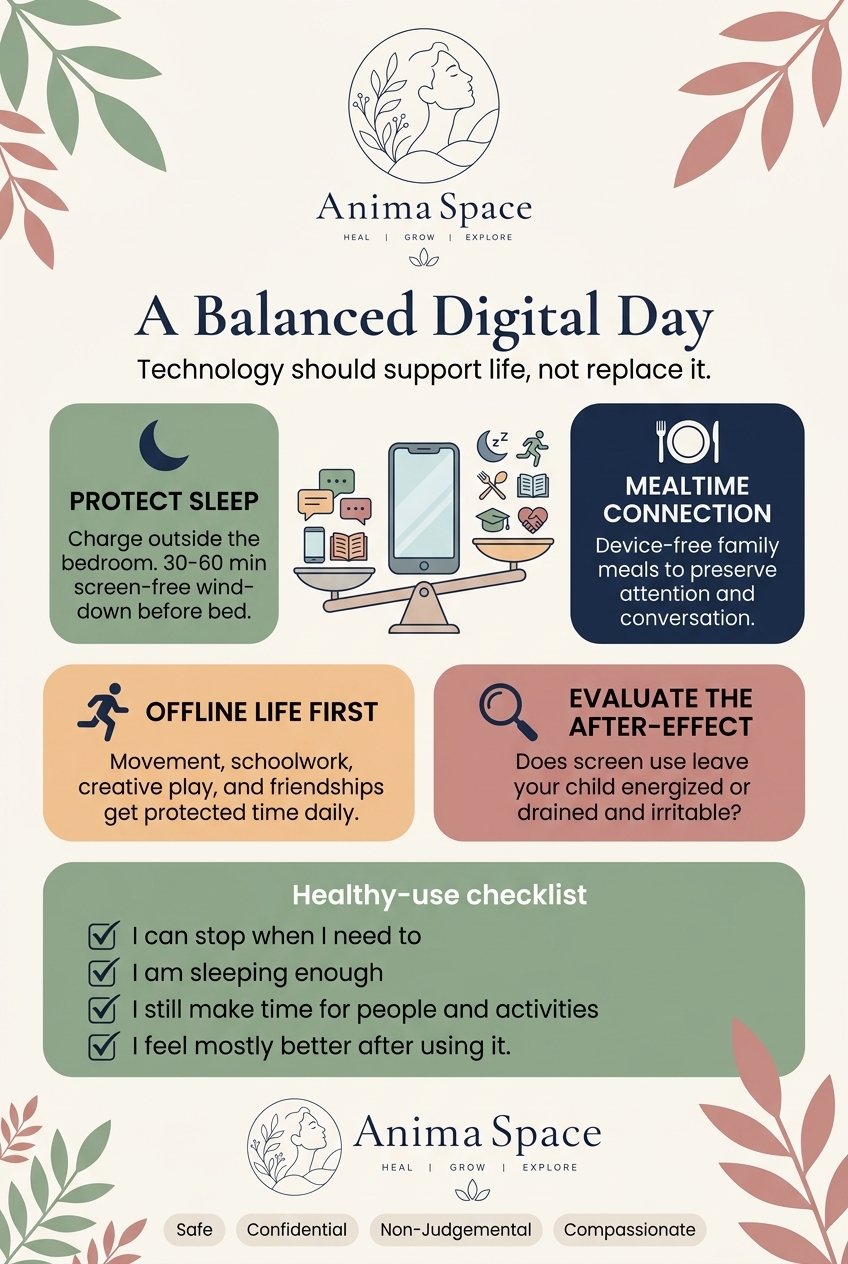
Anima Space infographic: A Balanced Digital Day — practical family guide to protect sleep, mealtime connection, offline life, and evaluate screen use after-effects.
A Balanced Digital Day
Technology should support life, not replace it.
Protect Sleep
Keep chargers outside the bedroom and build a 30–60 minute screen-free wind-down buffer before bedtime.
Mealtime Connection
Designate family mealtimes as device-free zones to preserve attention, presence, and open conversation.
Offline Life First
Ensure physical movement, schoolwork, creative play, and face-to-face friendships have protected time daily.
Evaluate the After-Effect
Regularly ask whether screen activities leave your child feeling energized or drained and irritable.

Prashanthi Simon
Psychologist, Writer, Communications Trainer, Well-being Coach, Career Counsellor, & Child Psychologist with 15+ years of experience.
Learn more about Prashanthi →