
Many parents feel at a loss when their child is overwhelmed by emotion. Here's a simple framework that helps children name, understand, and manage what they feel.
When children are overwhelmed, adults often want to stop the crying, anger, fear, or frustration as quickly as possible. We may say, “Calm down,” “It is not a big deal,” or “There is nothing to be upset about.” These phrases usually come from care, but they can leave a child feeling misunderstood. Before children can manage a strong emotion, they often need help recognising what is happening inside them.
A useful conversation can follow four gentle steps: Name, Notice, Need, Next.
1. Name the feeling
Begin with an observation rather than an accusation. “Your fists are tight and your voice is loud. I wonder if you are feeling angry.” You can offer a few possibilities without insisting that you are right: “Is it anger, disappointment, or worry?”
Children may not know the exact word. That is okay. Start with basic language such as happy, sad, angry, scared, disappointed, embarrassed, or frustrated. A feelings chart can help, but your tone matters more than the perfect label.
2. Notice what the feeling is doing
Help the child connect emotion with body sensations, thoughts, and actions. Ask, “Where do you feel it in your body?” or “What happened just before the feeling became bigger?” This teaches the child that emotions have signals and patterns. It also creates a small pause between the feeling and the behaviour.
Keep the conversation short during the peak of a meltdown. A dysregulated child may not be ready for a long explanation. First offer safety, space, water, a slower voice, or a quiet presence. Reflection can happen later, when the child’s body is calmer.
3. Discover the need
Every feeling carries information, even when the behaviour needs a limit. Anger may point to unfairness or frustration. Sadness may need comfort. Fear may need reassurance and a clear plan. Overwhelm may need fewer words and a break.
Try asking, “What would help your body feel a little safer right now?” The answer may be a hug, quiet time, help with a task, or simply knowing that an adult will stay nearby. If physical aggression or unsafe behaviour occurs, hold the boundary calmly: “I will not let you hit. I will help you be safe.”
4. Choose the next small step
Do not expect a child to solve the entire problem while upset. Offer two manageable choices: “Would you like to sit here or take three slow breaths with me?” Later, help the child plan what to try next time. Praise the repair as well as the calm: “You were very upset, and you came back to talk. That took courage.”
Children learn emotional regulation through repeated experiences with safe, steady adults. The aim is not to make difficult feelings disappear. It is to show that feelings can be named, listened to, and expressed without harming themselves or others.
If intense emotions are frequent, last a long time, cause significant impairment, or are accompanied by safety concerns, professional support is appropriate. Seeking help is not a sign that a family has failed. It is one way of giving a child more tools and giving caregivers more support.
“Connection comes before correction. When a child feels understood, learning becomes easier.”
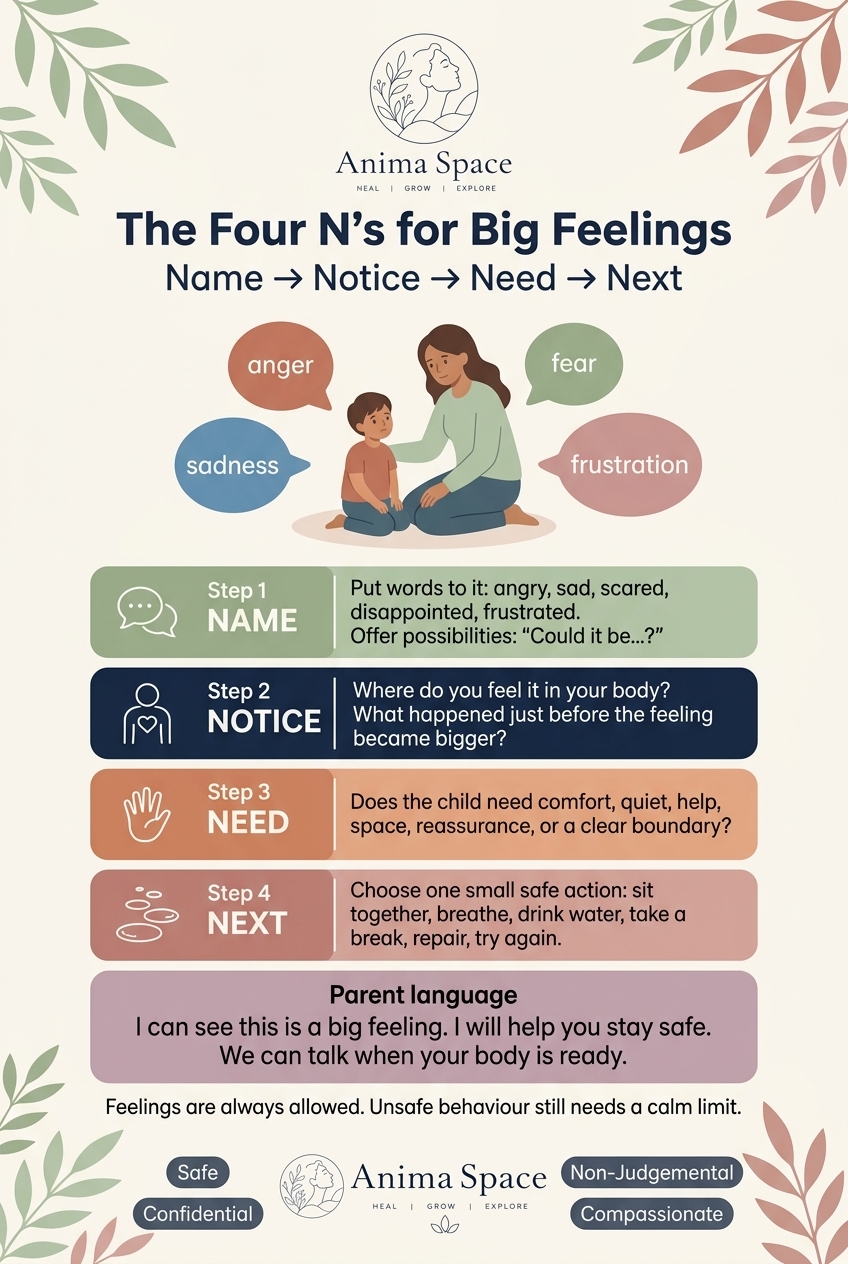
Anima Space infographic: The Four N's for Big Feelings — a step-by-step parenting guide to Name, Notice, Need, and take the Next small step when children experience strong emotions.
The Four N's for Big Feelings
Name → Notice → Need → Next
1. Name
Put gentle words to the emotion: 'I wonder if you are feeling angry, sad, scared, or disappointed.'
2. Notice
Identify body sensations (tight chest, clenched fists, stomach) and what triggered the surge.
3. Need
Explore the underlying need: comfort, quiet time, help, reassurance, or a safe and steady limit.
4. Next
Choose one small safe step together: deep breaths, a sip of water, or a quiet pause before re-engaging.

Prashanthi Simon
Psychologist, Writer, Communications Trainer, Well-being Coach, Career Counsellor, & Child Psychologist with 15+ years of experience.
Learn more about Prashanthi →